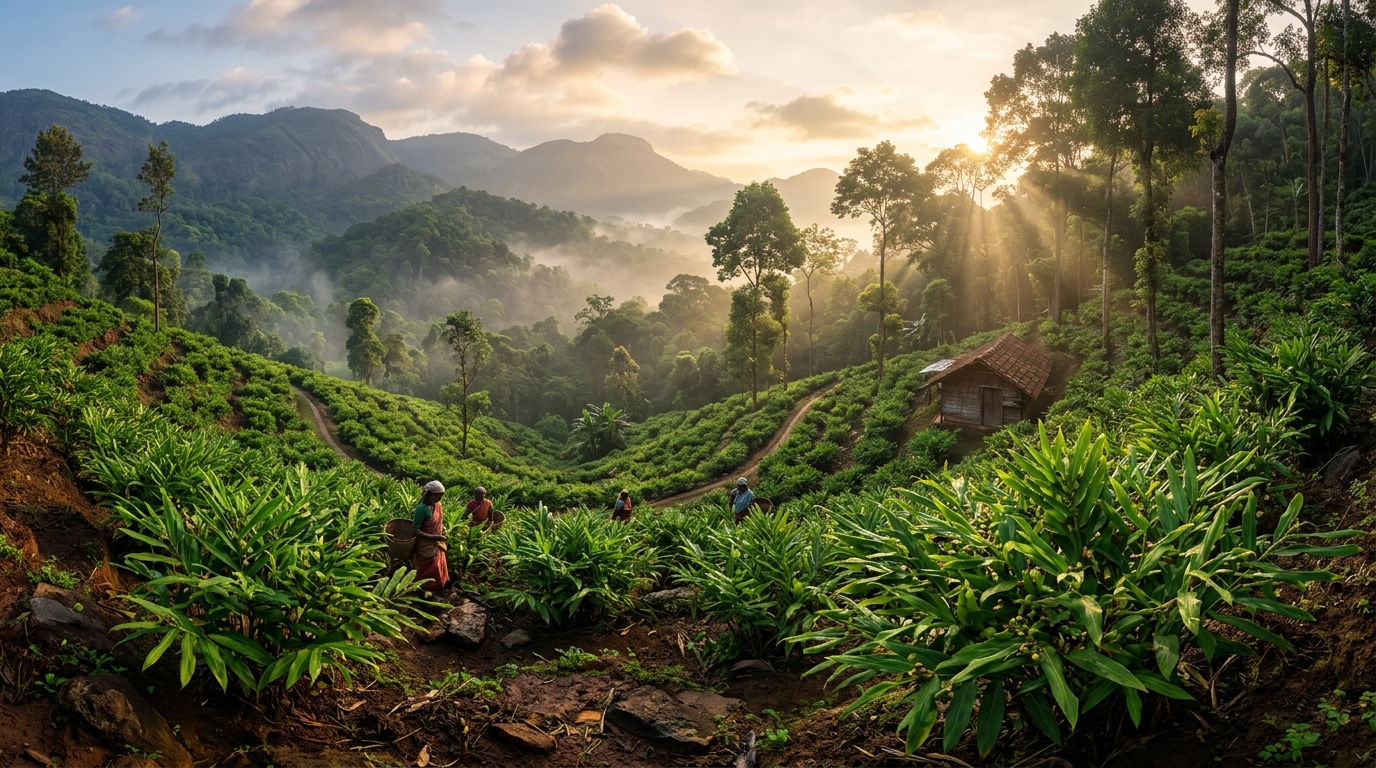
Cardamom: The Little Green Pod That Travelled the World
From the forests of the Western Ghats to the Plant Earth Organics kitchen
There are spices that add heat. There are spices that add colour. And then there are spices that change the aroma of an entire room.
Cardamom belongs to that last group.
Crush a single green pod between your fingers and its fragrance immediately rises—sweet, floral, warm and slightly citrus-like. Put it into a cup of tea and the drink changes. Add it to coffee and the character of the cup changes.
Put it into biryani, payasam or a traditional dessert and suddenly the dish carries a fragrance that people recognize even before they taste it. But behind that tiny green pod is a much bigger story—a story of forests, mountains, farmers, trade routes, harvests, markets, changing cultivation techniques and generations of people who learned how to work with one of the world’s most delicate spices.
Before the pouch, there was the forest
Small cardamom, scientifically known as Elettaria cardamomum, belongs to the ginger family (Zingiberaceae). Its natural home is associated with the evergreen, rain-rich forests of the Western Ghats of southern India. The plant is not a large tree—it is a perennial herbaceous plant that grows from underground rhizomes and produces its precious capsules close to the ground.
The hills of Idukki became especially important to this story. The cool mountain climate, high rainfall, shade canopy and rich humus soils create an environment where cardamom can thrive. When we look at a handful of cardamom in a kitchen today, it is easy to forget that the spice is a product of a very particular landscape: it likes humidity, rainfall, shade, mountain environments, and most importantly, people who understand how to cultivate it.
When cardamom became a traveller
Long before ecommerce, supermarkets and modern packaging, spices moved because people wanted what they could not easily grow themselves. Cardamom was one of those precious ingredients. Its fragrance made it valuable for food, beverages, and medicine, and its long association with spice commerce helped connect South Asian growing regions with markets far beyond the mountains.
The history of Kerala itself is inseparable from the spice trade. Pepper, cardamom and other spices helped make the Western Ghats part of a much larger commercial world.
— Plant Earth Spice Archives
There was no barcode. No modern warehouse. No refrigerated truck. No online order. A spice was harvested, dried, collected and traded through networks of farmers, merchants and maritime ports. And yet the reason for the journey was incredibly simple: someone somewhere wanted that fragrance.
From an Indian mountain crop to an international commodity
📊 India Small Cardamom Trade & Economic Landscape (2024–25)
According to Kerala’s Economic Review 2025 (based on Spices Board data), India exported 6,728 tonnes of small cardamom in 2024–25, valued at about ₹1,566.82 crore. That tells us something important: the story that started in the forests and plantations of South India did not stay there. It became global.
A green capsule harvested in Kerala can eventually become part of a cup of coffee in the Middle East, a dessert in Europe, or a biryani in an Indian home thousands of kilometres away.
But before the world sees the cardamom, the farmer sees it first
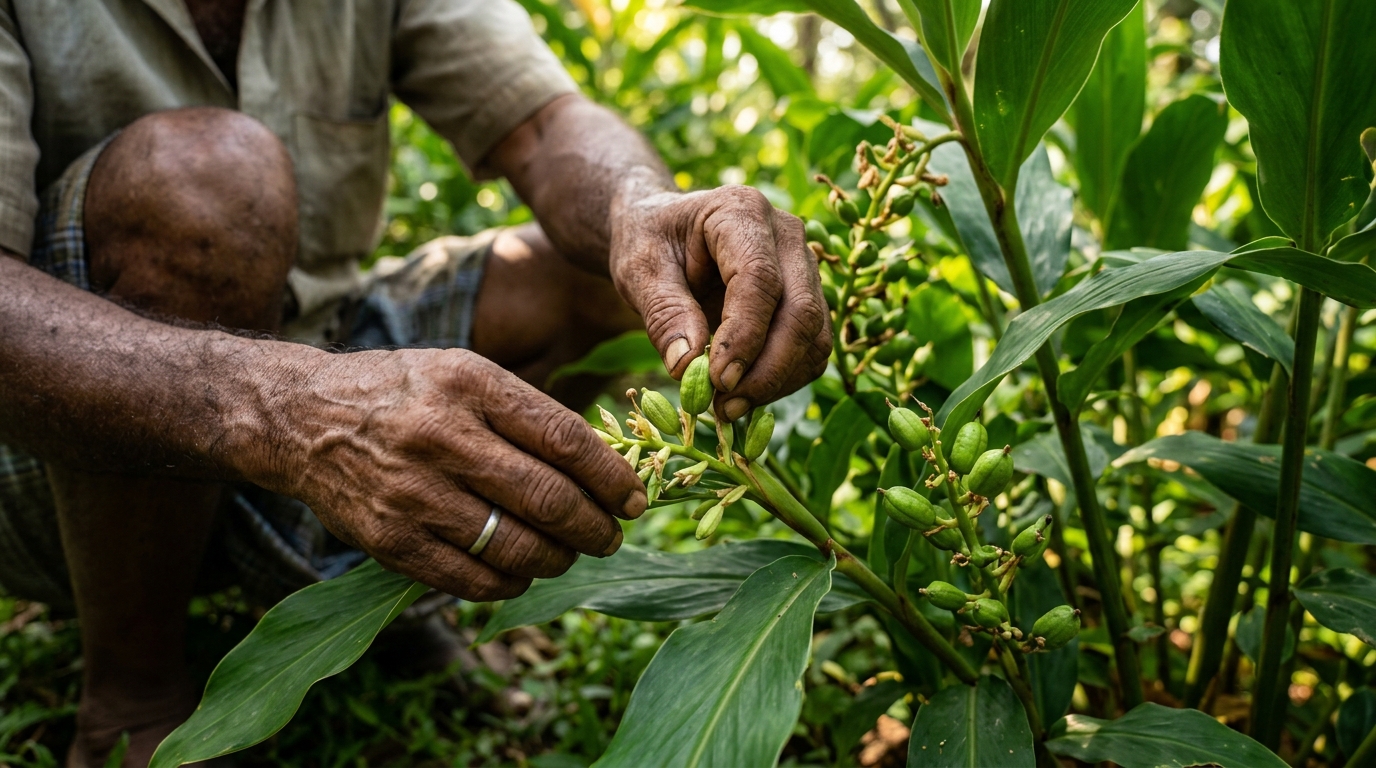
This is the part of the story that is often missing from product descriptions. A cardamom farmer doesn’t simply plant a crop and wait. Cardamom needs continuous attention. The farmer manages the plantation environment, shade, soil, moisture, nutrients, weeds, pests and diseases beneath a carefully managed canopy.
The cardamom capsule develops from panicles (flowering stalks) produced near the base of the plant. The farmer must watch the crop closely because the capsules do not all reach harvest maturity at exactly the same time. Harvesting is a repeated human process: a farmer walks through the plantation, looks carefully, finds mature capsules, picks them by hand, leaves immature capsules to continue developing, and returns again.
How does cardamom actually grow? Types & Varieties
- Malabar: Prostrate panicles (flowering structures spread/droop close to ground). Smaller, highly aromatic capsules.
- Mysore: Robust plants with erect panicles and bold, larger capsules. Suited for higher altitude plantations.
- Vazhukka: Semi-erect panicles with characteristics intermediate between Malabar & Mysore. Extensively cultivated in Kerala.
- ICRI Hybrids: Selections developed by the Indian Cardamom Research Institute (Myladumpara, Idukki) for disease resistance & high yields.
From flower to green capsule & post-harvest curing
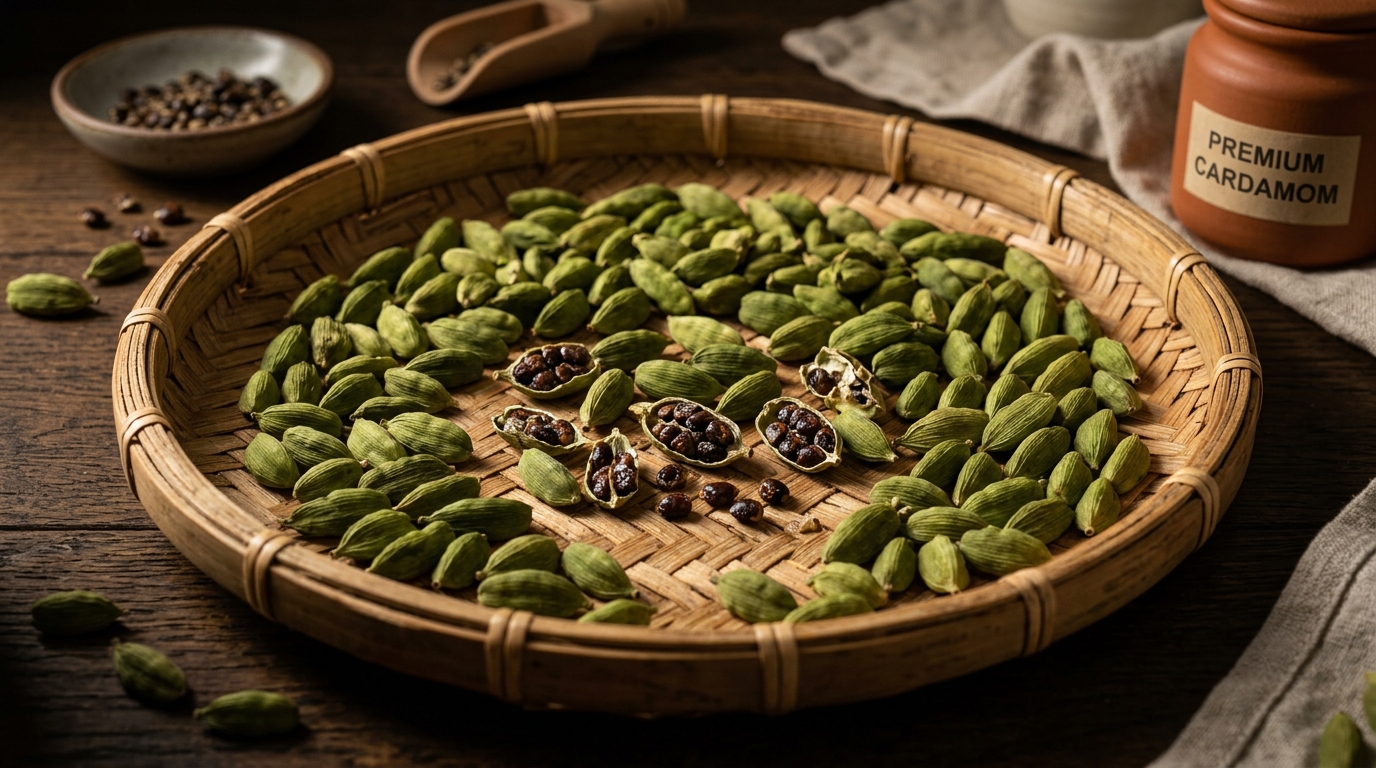
Once the fresh capsules leave the plantation, they are not yet the cardamom we recognize in the kitchen. They contain considerable moisture and need skilled post-harvest curing. The journey follows: Harvest → Cleaning → Curing/Drying → Grading → Storage → Packaging.
The curing process affects colour, aroma retention, essential oil concentration, and shelf life. Indian cardamom is traded under prestigious international grades including Alleppey Green Extra Bold (AGEB), Alleppey Green Bold (AGB), and Alleppey Green Superior (AGS).
Cardamom in the Kitchen & Essential Aromatic Science
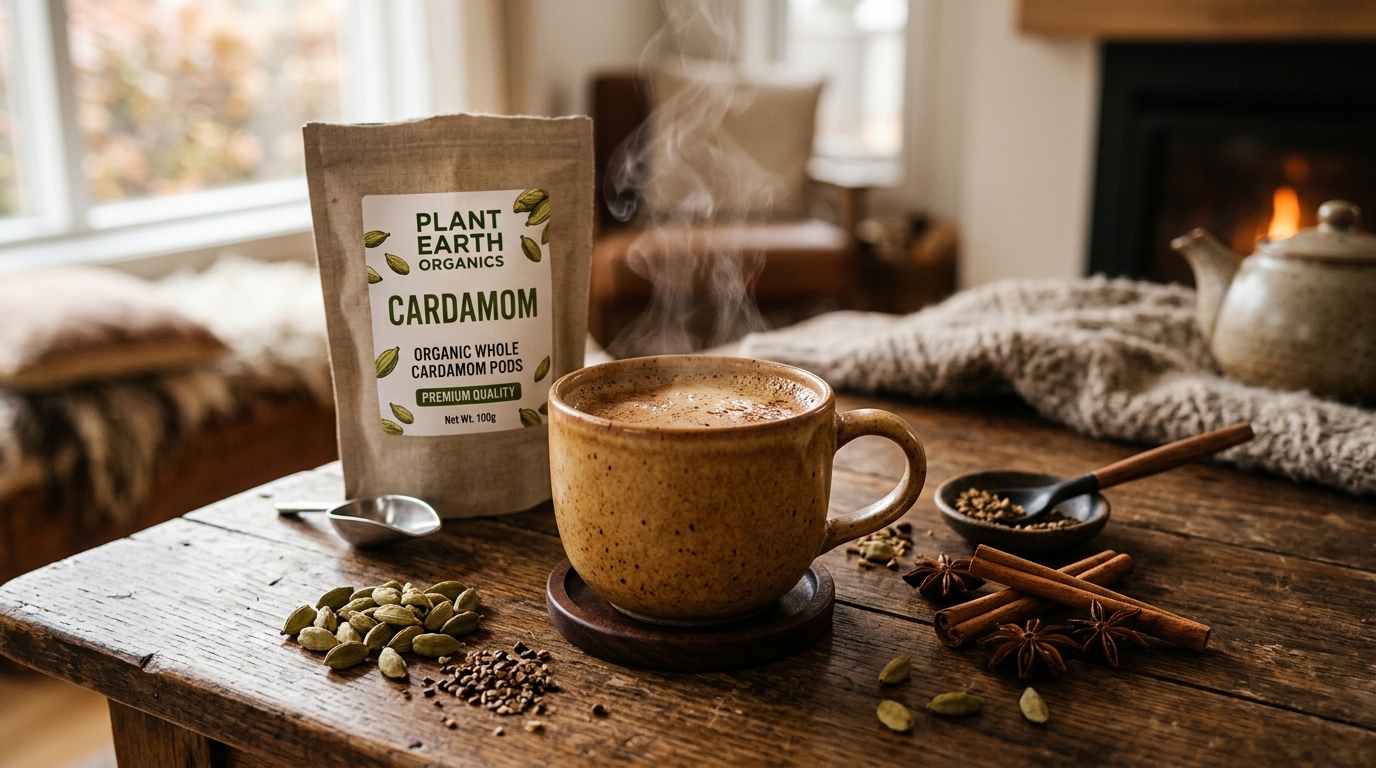
- Cardamom Tea (Chai): Lightly crushed pods added during boiling release 1,8-cineole and terpinyl acetate for a refreshing, warm beverage.
- Cardamom Coffee (Gahwa): Traditional Middle Eastern & South Indian style fragrant coffee blend.
- Biryani & Pulao: Whole pods fried in ghee or simmered in broth infuse rice with delicate, floral top notes.
- Payasam & Sweets: Essential aromatic component for Indian milk, rice, and semolina desserts (ladoos, halwa, kheer).
- Baking & Masala Blends: Adds complex warm-citrus notes to cookies, spiced breads, and garam masala.
The Historical Cardamom Timeline
⏳ The Journey of Cardamom Through Time
Ancient Forest Origins
Ancient EraCardamom grows wild in the humid rainforests of the Western Ghats; used in traditional Ayurvedic food preparations.
Maritime Spice Route
300 BCE – 1500 CEKerala cardamom becomes a prized export carried by Arab, Roman, and Phoenician traders across the Indian Ocean.
Plantation Development
19th – 20th CenturyOrganized highland cultivation begins in the high-altitude forests of Idukki and Wayanad.
Modern Research & Grading
Late 20th CenturyEstablishment of Indian Cardamom Research Institute (ICRI Myladumpara) and standardized Alleppey Green grading.
Plant Earth Organics
Present DayDirect farm-to-kitchen ethical sourcing, zero synthetic dye, and moisture-barrier zip lock packaging.
Your Kitchen Table
EverydayOne green pod transforms a cup of tea or festive biryani into lasting sensory memories.
Why Plant Earth Organics?
Buying a spice should not mean buying a mystery. At Plant Earth Organics, our approach is built around natural products, careful selection, and a direct connection to origin. The goal is not to make the ingredient look different with artificial dyes or chemical sprays—the goal is to let the ingredient speak for itself.
From the green hills to the farmer, to the market, to Plant Earth, and finally to your kitchen—we don’t claim to own the story of cardamom. We are simply honoured to become part of it.
Experience Pure Idukki Spices
Experience the pure, unadulterated aroma of authentic Idukki Green Cardamom. Sourced directly from shade-grown forest plantations in Kerala.
Shop Plant Earth Green CardamomFounded in 2025.
Grown Long Before That.
Two journeys, one story: how Plant Earth was built around the farmer — and how a single cardamom pod travels from a forest flower to your kitchen.
Small flowers form close to the ground, sheltered in the shade of the forest canopy.
Where It Started
Plant Earth Organics was founded in 2025 on a simple frustration: good spice, grown with real care, was disappearing into long anonymous supply chains before it ever reached a kitchen — and the farmer behind it benefited least of anyone.
Founded · 2025A Chain With Too Many Links
The typical route a spice takes before it reaches a shelf:
Every link adds a markup and a delay — and takes the spice one step further from anyone who could vouch for where it actually came from.
We Chose to Go Direct
Instead of buying into that chain, we removed it. We'd go to the growers ourselves, buy directly from named farms, and sell straight to the people cooking with the spice — no traders, no aggregators, no unnamed hands in between.
Not Transactions — Relationships
Every farm we buy from is one we've actually visited. We agree to keep coming back season after season, instead of chasing the lowest price at auction each time — which means we can pay for quality effort instead of letting it disappear into an average lot price.
Known farms · Repeat seasons · Fair, direct pricingTo show you what "direct" actually looks like, follow one spice all the way from a forest flower to your cup: cardamom.
Born in the Western Ghats
Long before cardamom reached spice shelves, it grew wild in the cool, rain-rich forests of the Western Ghats — still recognised today as its true centre of origin, and where our own growers still cultivate it.
Western Ghats, South IndiaShade, Rain, Altitude
Cardamom grows as a perennial herb from underground rhizomes, sheltered beneath taller trees, thriving between roughly 600 and 1,200 metres of elevation where humidity and rainfall stay high and steady — the exact conditions of Idukki, Kerala.
Idukki, Kerala · ~900m elevationWatched Over, Season After Season
Cardamom asks for attention across the whole year — shade, soil, water and nutrients, pests and disease — before the plant ever flowers. The farmer we buy from has walked this same plantation for years, which is exactly why we trust what comes off it.
Months of cultivation, per plantWhere the Aroma Begins
A flower forms close to the base of the plant. Once pollinated, it swells into a small green capsule holding numerous tiny dark seeds — the seeds where cardamom's essential fragrance actually lives.
Flower → pollination → green capsulePicked by Hand, One Pod at a Time
Capsules ripen unevenly, so harvest isn't one event — it's a repeated, careful walk through the plantation, picking only what's ready and leaving the rest to mature. Every pod represents months of that quiet, repeated care.
Hand-picked, pod by podCleaned, Cured, Dried
Fresh capsules hold too much moisture to store. They're cleaned, sorted, cured and dried — the stage that decides the final colour, aroma and shelf life of every pod we go on to sell.
Harvest → cure → grade → packColour "Isn't" the Whole Story
Real quality is a combination of capsule size, weight, colour, aroma, seed development, moisture and cleanliness. Because we know exactly which farm every batch came from, we can grade and stand behind each one honestly, without blending it into an anonymous average.
One Spice, Many Cultivars
Green cardamom (Elettaria cardamomum) is what this journey follows — a different plant entirely from smoke-dried black cardamom. Within green cardamom, the classic types are Malabar, Mysore and Vazhukka, and growers know their crop by farm-level names too:
Farm to Warehouse, Nothing Extra
That dried pod moves straight from the farm into our own grading and packing — the shortest route we can build, so nothing sits unaccounted for in an unknown hand along the way.
Built to Sell Direct, Too
We built Plant Earth as an e-commerce brand from day one, so the same directness runs all the way to checkout — no distributor shelf, no retail markup stack, no disconnect between the farmer you just met and the pouch that lands at your door.
From Pod to Everyday Ritual
This is where the whole journey pays off — one crushed pod turning tea, coffee, biryani or a Kerala payasam into something unmistakably its own.
Still Going to the Farm Ourselves
Since 2025, that's stayed the model. Every pod, one crushed into your tea included, can be traced back to one farm, one farmer, one harvest — because that's exactly how we bought it.
Know the origin. Taste the difference.